From the makers of the Empathy Box, Tribeless Co. is currently conducting a global experiment in creating safe spaces online. I and 20 something other hosts from around the world are going to host Empathy Circles, the virtual spin-off of the Empathy Box.
What is the Empathy Box?
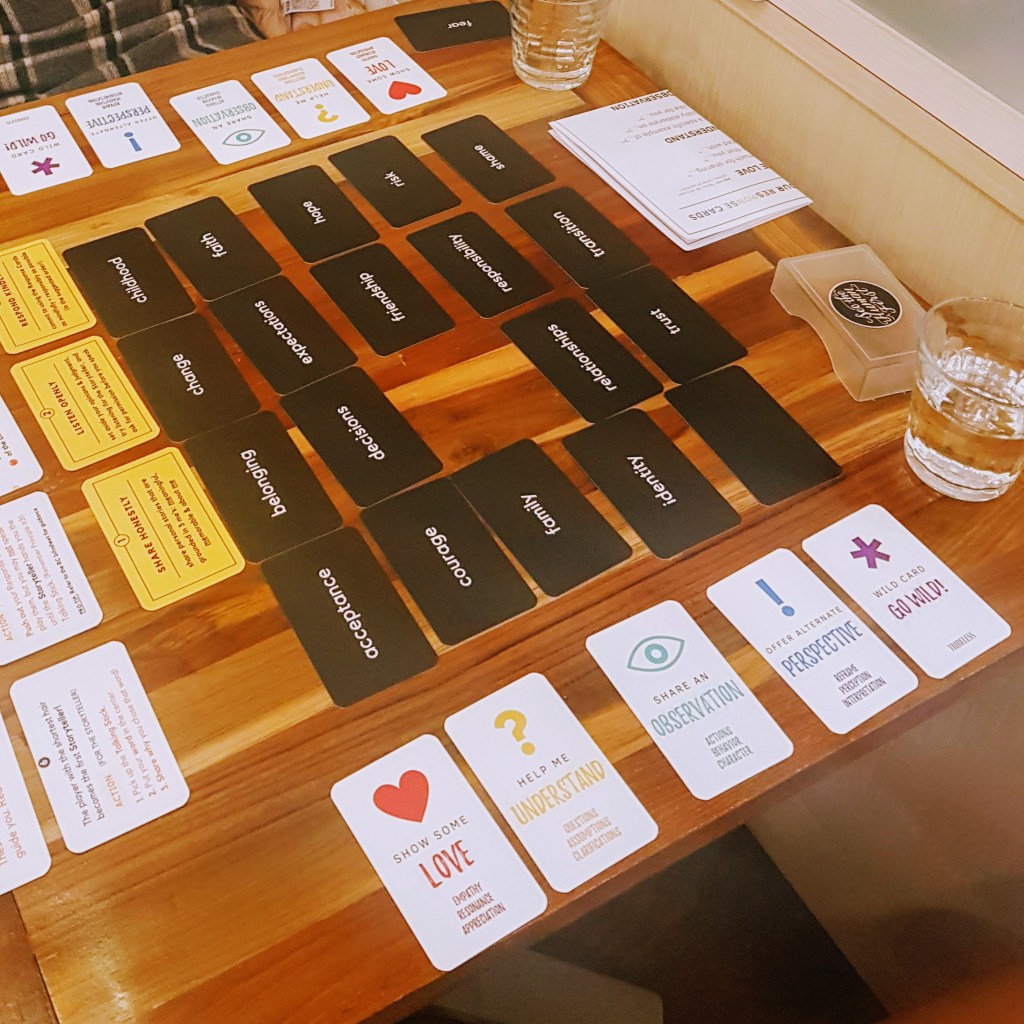
It’s a card-based facilitation tool that helps foster deeper and meaningful conversations in our fast-paced digital world. And helps us practice Empathy.
2 months ago, I applied for a scholarship to get my own copy of the box to use for a variety of facilitation work and team building activities. I was interviewed by Shawn (who told me he’s the all-around admin guy but he’s really the CEO of the company, so humble.) He seem to like my answer so in return for going through scholarship, I had to write a report on how it created an effect (or not) in terms of facilitation and having conversations. I have used it twice so far and then COVID-19 happened.
With most people shifted to working from home, prior to Tribeless inviting me to take part in this activity, I was already wondering how to recreate this online. I was planning to do this with a friend who also does a similar line of work to mine who suddenly went back to Canada and asked me if we could do it over the Internet.
So to help me get the hang of facilitating virtually, I decided to join this initiative. I just finished my first session a few hours ago with a friend and her friends whom I haven’t met.
Preparation Work
Tribeless was kind enough to provide the initial materials to kickstart your own Empathy Circle. As with any facilitation work, you setup the environment to the best of your abilities to make it as smooth as possible, and that takes a lot of time and effort. Even more so when you do things remotely.
- Preparation work would take at least twice the time of the actual workshop. (An activity of 2 hours would require at least 4 hours of preparation work.)
- Understand the slide flow, the speaker notes to ensure smooth transition of the activity
- Make sure all the materials/tools you will be using are organised to your liking (if I’m sharing multiple things on the browser, even the tab order is essential)
- Test your peripherals prior. I have never hosted an event like this through Zoom. So using my mobile, personal and work laptop, I tested to see how the call looks like from both guest and host perspectives.
- Since it’s not a work thing, I used Line to send updates and what they need to bring and how they need to show up for the session.
- Breathe. (I always feel anxious just before any facilitation work)
The Session Itself
It was new for me to facilitate a group of people I barely know that is not in a work setting. I felt nervous explaining the session and missed some minor details. Since I was also a participant, my focus was split in being present for every participant and still in touch with the big-picture awareness of the session. That was the most challenging part for me. The mindfulness it requires is vast, and I need to remember to treat it the same way as a face to face activity. At one point, I had question for a participant and I completely forgot what I was going to ask (I learnt quickly and wrote my question down on the next try).
There were instances when I was looking at them and I wasn’t even sure what the current mood is. I could see their shifts in movement and how they look at the camera, but my mind is blank. There is no air to read.
空気を読みたかったけど、読める空気がない。
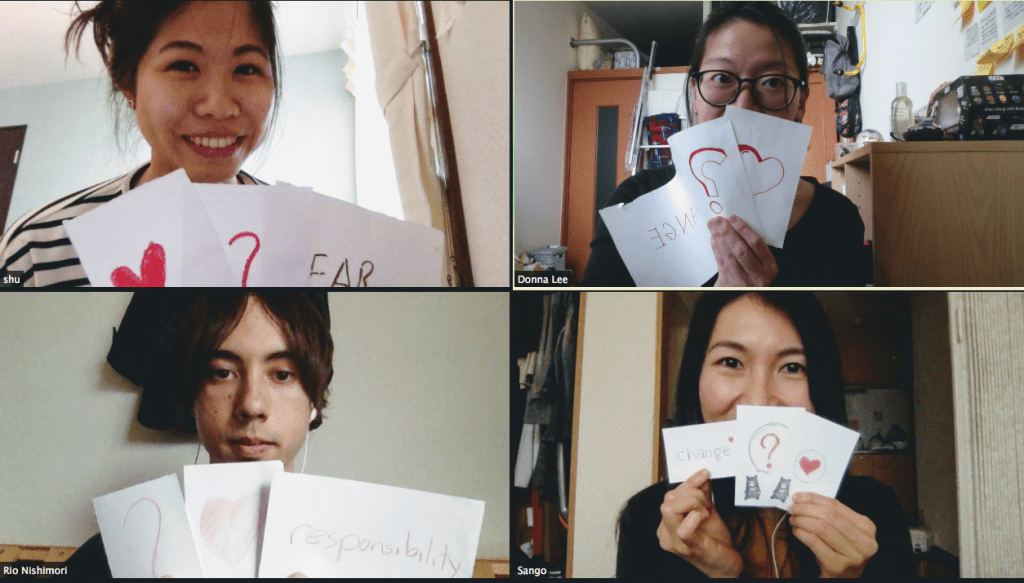
We were able to finish with lots of time to spare. From here, I could sense the mood of the group was light and people seemed to have been able to open up. It helped that my friend have done this before with me, and the group is curious enough to participate. They also agreed to have their “photo” taken.
Reflection
Needless to say, I am still new to online facilitation. It is more demanding in terms of tools (I am not fond of slides and prefer using a whiteboard and Post-its) and my observation is limited to what I can see on my screen. This was the first session and it went better than I expected. With this work, you never know what will happen until you actually do it, and you just respond to what is happening at the present moment.
Some observations :
- As a participant/facilitator, write down questions when listening to another person’s story due to multi-tasking
- Remove the screen share during the story session so that people can see each other better
Let’s see how my next session will fare. I will be doing this with more participants next session with an interesting mix of people, so it will be a new experience again.
Interested to join the movement?
If you want to be a host or try the #EmpathyCircles as a participant you can check more information here http://empathycircles.tribeless.co/
As a facilitator, a change agent, a colleague, a teammate, a friend, a family member and most of all, a human being, I truly believe love, kindness and empathy will always win.
 Hello, I am D.